Andaman and Nicobar Islands are more or less scattered like a pearl necklace over the vast waters of Bay of Bengal...almost 1200 kilometres away from the Indian Subcontinent. One can estimate that these islands are quite far away from the coastal regions...
The beauty of these islands are world famous. Quite obvious to the fact, people travel from all over the world to enjoy this scenic beauty. In the midst of this beautiful environment lies an unknown history.....The islands which we are talking about was once compared with the beauty of Paris...The Ross Islands.

Ross Islands is a tiny little island at the mouth of the Port Blair Harbour. It is in fact, the entry point into the Andaman Islands. At one point in no time, it served as the capital of the British in this part of India. It was a township that had everything one may need to live a lavish life in. But today this island lies forgotten, deserted and totally abandoned....
Ross Island was a great symbol of British domination in the beginning of the 20th century. The officers had their headquarters located here. Once touted as the ‘Paris of The East’, the colonial edifices on this island are now in dilapidated conditions. In its heyday, Ross island was used by British as a penal settlement center for the political prisoners.

According to the British custom, a place was named after that particular officer surveyed or discovered that very area. And as the name suggests, Ross Island was named after British officer Daniel Ross and Port Blair was named after Sir Archibald Blair.
After the revolt of 1857, the British officers wanted to keep the prisoners of freedom struggle far away from India. Hence they decided to choose Andaman as their penal colony. The first jetty arrived on 10th March, 1858, which had almost 200 prisoners and were directly transferred to Ross Island.
Ross Island was mainly a residential area for British officers and their families. It had each and every facility availed by the Britishers which was supposed to be in a well prospered European city. The colonial rulers coerced inmates into cleaning the tropical jungle and built a mini town for themselves. From the commissioner’s fancy bungalow to a secretariat, from the Italian tiled clubs to a church, the inmates built all from scratch. But now, it stands aloof, silent and abandoned.


Ross Island was an indeed a beautiful city and well prospered equally. The Presbyterian church is considered as one of the most finest masterpieces here, with a glimpse of its royalty. It had a 5 storeyed tall bell tower, with the bell as heavy as required to pull it using 8 pulleys. It was the first island in Andaman to have the facilty of electricity.

The English were not acquainted with its tropical climate and would often fall sick even after drinking its water. Hence they installed a water distilling plant here brought from England.
The famous Bakery at Ross Island is the only existing building now with quite a decent condition. This bakery was one and all in the whole of Andaman. The large round like structure inside the bakery served as the furnace, or the stove which was used for making cakes, bread etc.

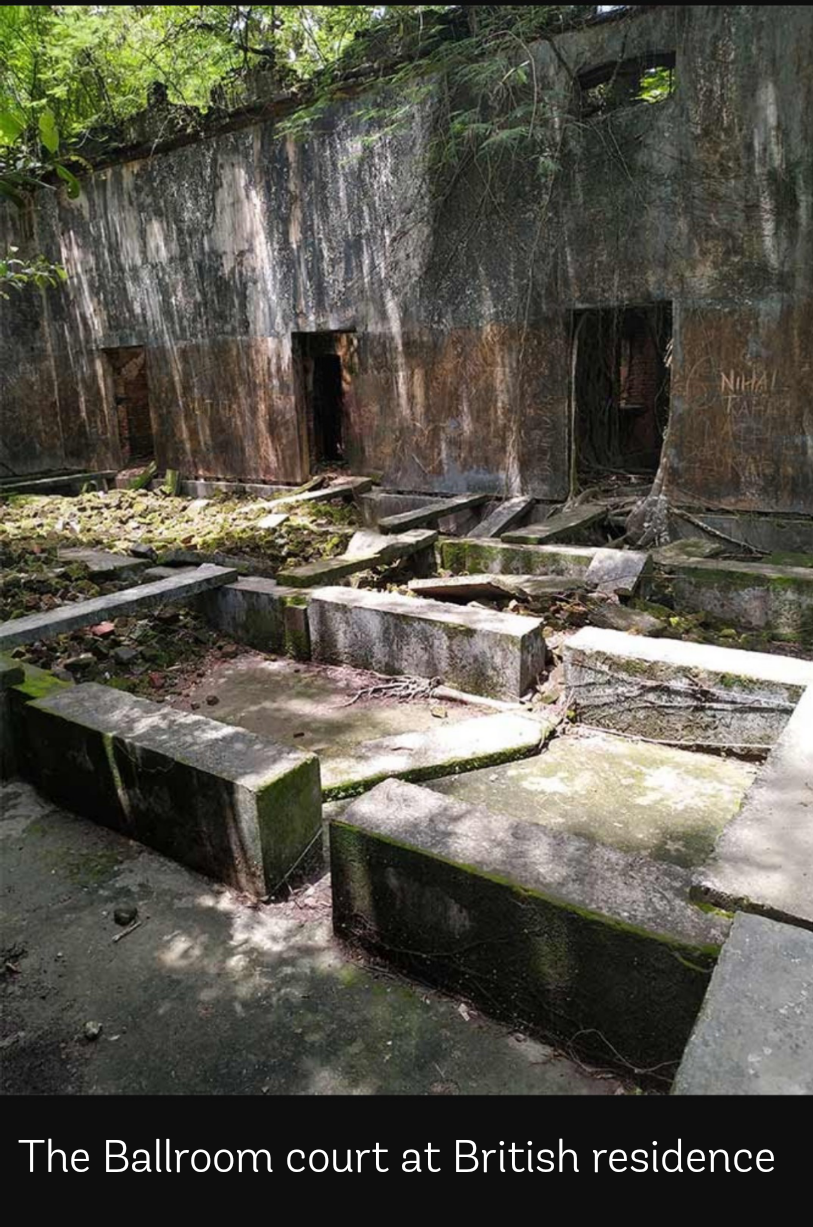
The Commissioner's bungalow is one of the tallest building in Ross Island. Accompanied by many security guards, it had 8 rooms, 2 sitting rooms and equal number of dining halls as well, along with a tennis court, A ballroom court and a separate stairway for exit. The British Infantry Barracks were installed close to this building. The tiles used were the expensive ones from Italy, and teak from Burma.


After the revolt of 1857, the maximum war prisoners once served as a soldier for the British army. To seal their chances of revolting again, these war prisoners were decided to send to a far away place from India. Ross Island was best suited for this purpose because the waterways served as a great help to the Britishers and the availability of water was also an important factor.
The prisoners were badly tortured, tied in chains and were made to work as labourers, especially the work of carving stones. They were subjected to endless torture and brutal punishments.

It is believed that Ross Island lost its identity after the earthquake of 1939, and cracks started emerging in the middle of these islands. An area of almost 200 acres, 130 of it got submerged due to earthquake, and now only 70 acres of its land is in its existent form. Rumors spread around that Ross Island would sink soon, as a result many English officers left that place along with their families.
During the Second World War, the Japanese forces attacked Ross Islands and burnt all the administrative buildings to end the British supremacy over there. The prisoners were released and the then Chief Commissioner, Mr. Waterfall was arrested.
The Commissioner's building was taken over by them and Japanese bunkers were setup. While this was going on, Netaji Subhas Chandra Bose once visited Ross Island and hoisted the Indian National Flag at the top of the Commissioner's building.

Immediately after the Second World War, the British captured the Ross Islands again on 1945 and finally surrendered it to the Indian Government on August 1947. Ross Island was left deserted thereafter with no signs of development. After many years hence, one wing of Indian Navy took over its responsibility and established a Naval Depo to restore the history and culture of this place.
One of the remarkable islands of Andaman and Nicobar, a jewel in the crown of British Raj, a penal colony which once glorified the British worth, enclosed within the horrors of torture and cruelty of the war prisoners, a symbol of British Supremacy, now stands aloof, silent and abandoned. Compared no less than a European city, it seems that Ross Island is actually engulfed within its curse of the horrifying punishments subjected to war prisoners. As history repeats itself...the place were prisoners were left deserted, is now itself lying abandoned. Myths, stories and folktales....they are...and they'll always be with them.
#rossislands #andamannicobar #portblair #penalcolony #britishers #english #symbolofenglishpride #worldwars #prisoners #torture #stories #folklores #myths #theunheardsecrets
Wow❤
ReplyDeleteThank u♥️♥️
DeleteVery nice
ReplyDeleteThank u so much
DeleteDamn!🔥
ReplyDeleteThanks a bunch!!
DeleteThank u so much
ReplyDeleteThank you for this wonderful piece of information 🐣👌🏻
ReplyDeletePleasure🤗
Deletelovely ❣️
ReplyDeleteThank u😍
Delete